Pokemon TCG Playmat Guide: Tournament-Legal Sizes & Materials
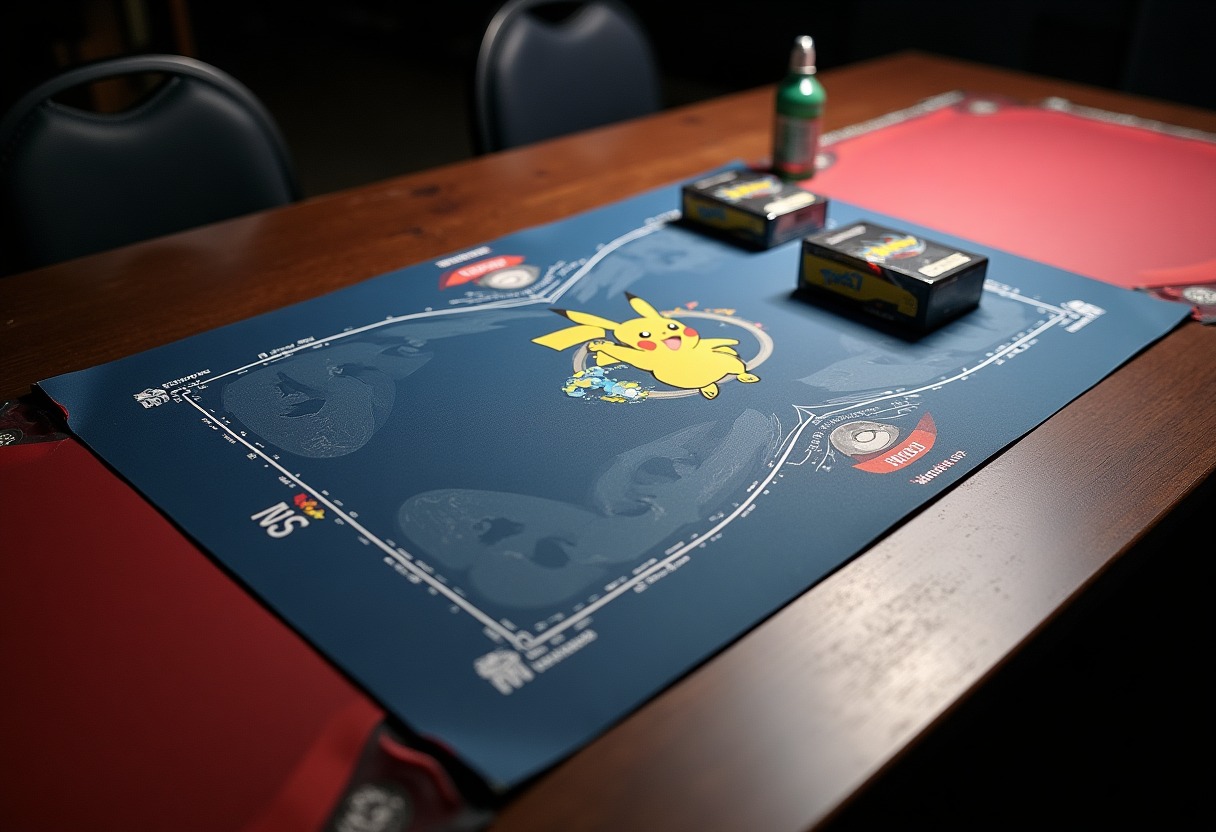
Your playmat gets inspected at registration, sits under every shuffle and draw for nine rounds, and determines whether your sleeves catch on fabric or glide smoothly during critical top-deck moments. The difference between a tournament-legal mat and one that gets flagged by a judge isn't just about printed dimensions — it's about rubber base grip, edge stitching durability, and whether your opponent can read your cards through a thin fabric layer.
Why Playmat Specifications Matter Beyond Aesthetics
The Pokémon Company International publishes explicit playmat requirements in their tournament rules documentation. The official standard is 24 inches wide by 14 inches tall, with a tolerance of ±0.5 inches. Judges measure mats that look questionable, and oversized promotional mats from some events fail this check.
Material composition directly affects card protection and shuffle consistency. Rubber-backed cloth playmats provide the grip needed to prevent the mat from sliding during aggressive shuffles, while pure neoprene mats offer water resistance that matters when players knock over drinks at 10 PM during day two. The fabric surface needs enough texture to prevent sleeved cards from sliding uncontrollably but not so much friction that riffle shuffles feel rough.
Edge stitching prevents fraying after months of rolling, unrolling, and storing in → Shop playmat tube case on Amazon. Unstitched edges on budget mats show wear within 15-20 tournament cycles, with corner fabric separating first. Competitive players who attend monthly regionals need mats that survive at least 50 tournament days before replacement becomes necessary.
Tournament-Legal Playmat Size Requirements and Measurement
The 24x14-inch standard exists to fit two play zones — yours and your opponent's — on a standard tournament table without overlap. Tables at Regional Championships measure 48 inches across, allowing two 24-inch mats side-by-side with zero margin for error. Mats measuring 25x15 inches create physical interference, and judges will ask you to replace them before round one starts.
Custom printed playmats often arrive at 24x13.5 or 23.5x14 inches due to manufacturing variance. Printer template settings default to standard dimensions, but fabric shrinkage during heat pressing or edge finishing reduces final measurements by 0.25-0.75 inches. Order confirmation emails should specify pre-production measurements, and reputable printers guarantee ±0.25-inch tolerance or offer reprints.
Zone layout matters as much as total size. Your active Pokémon spot, bench area, discard pile, and prize cards all need designated space. A well-designed playmat includes subtle zone indicators without cluttering the playing surface with excessive graphics that distract from actual card positions. Players using Best Card Protectors Organizers alongside their mats need extra millimeters near the prize card area for acrylic damage counters and status markers.
Thickness ranges from 2mm to 4mm across popular brands. Thinner 2mm mats roll tighter for storage tubes but offer less cushioning on hard tables. Thicker 4mm options provide better card protection when placing down sleeved decks but create a noticeable edge lip that some players find distracting. The 3mm middle ground balances portability with surface protection.
Material Comparison: Rubber-Backed Cloth vs Neoprene vs Microfiber
Material selection determines durability under tournament stress and cleaning requirements between events. Each composition handles spills, repeated rolling, and shuffle wear differently:
| Material | Grip Quality | Water Resistance | Durability (tournaments) | Cleaning Method | |----------|--------------|------------------|-------------------------|-----------------| | Rubber-backed cloth | Excellent (no sliding during shuffles) | Poor (absorbs spills) | 40-60 events before edge wear | Spot clean, air dry 24hrs | | Neoprene | Good (slight movement on smooth tables) | Excellent (waterproof) | 30-50 events, corner curling common | Hand wash, flat dry | | Microfiber blend | Moderate (needs table texture) | Moderate (water beads initially) | 50-70 events, graphic fade after 40 | Machine wash cold, low heat | | Stitched rubber-cloth hybrid | Excellent (locked edges prevent curling) | Good (sealed edges block wicking) | 60-80 events before stitching loosens | Spot clean only, no submersion |
Rubber-backed cloth remains the competitive standard because it stays flat during aggressive pile shuffles and side shuffles. Players who practice Pokemon Tcg Deck Consistency Math Hypergeometric Probability Mulligans Optimal Counts know that shuffle quality directly affects draw consistency, and a playmat that slides or bunches introduces variance.
Neoprene excels in environments where drink spills happen frequently — coffee shops, casual league nights, or players who keep water bottles tableside during Pokemon Tcg Tournament Preparation. The sealed surface wipes clean immediately, preventing liquid from soaking through to the table or damaging sleeved cards. The tradeoff is corner curling after 6-8 months of tube storage, which requires reverse-rolling overnight before tournament play.
Microfiber blends offer the longest lifespan if you rotate between multiple mats. Graphic printing holds up better than dye-sublimation cloth, and machine washing removes the grime buildup that turns white mat borders gray after a tournament season. These mats work best for players who travel frequently and need something that survives baggage handlers and hotel rooms.
Brand Comparison: InkedGaming, Ultimate Guard, and Custom Print Services
InkedGaming dominates the custom playmat market with consistent 24x14 dimensions and rubber backing that grips tournament tables reliably. Their standard mats run $24.99 for solid designs, while custom printing starts at $29.99 with uploaded artwork. Print quality holds through 50+ tournament cycles before noticeable fading, and edge stitching survives rolling into standard tubes without fraying.
Ultimate Guard's Premium Play Mats target competitive players willing to pay $34.99-44.99 for thicker 3.5mm construction and reinforced stitched edges. These mats arrive slightly oversized at 24x13.5 inches, staying within tournament tolerance while maximizing zone space. The microfiber top layer resists staining better than standard cloth, and corner curling occurs less frequently than cheaper alternatives. Their exclusive Pokémon designs include officially licensed artwork that passes judge inspection without question.
Generic → Shop tournament playmat 24x14 on Amazon units from manufacturers like ENHANCE or Exco cost $15-20 but arrive with measurement variance between 23.5x13.75 and 24.25x14.25 inches. Edge stitching quality varies by production batch, with some mats showing loose threads after 10 tube insertions. These work for testing decks at home or casual league play but carry risk at higher-level events.
Print-on-demand services like Yourplaymat and Customplaymat charge $28-35 for uploaded designs with guaranteed tournament dimensions. Quality control depends on which production facility processes your order — US-based printing delivers faster but costs more, while overseas facilities offer $19.99 pricing with 3-4 week shipping and occasional color matching issues. Request a physical proof for orders over $40.
Custom artwork requires 300 DPI resolution at 24x14 inches (7200x4200 pixels minimum) to avoid pixelation on printed fabric. Most printers accept PNG, TIFF, or high-quality JPG files under 50MB. Design templates should account for a 0.25-inch bleed zone around all edges, since cutting and stitching remove outer pixels. Text smaller than 10pt becomes unreadable at playing distance.
Specific Playmat Recommendations for Competitive Players
For players attending monthly regionals who need mats that survive 40+ tournament days: → Shop rubber playmat gaming on Amazon offers stitched-edge rubber-backed options around $22-28 that balance durability with grip. The ENHANCE gaming mat specifically measures 24x14 inches and includes a reinforced carrying tube.
Custom designs through InkedGaming work best when you want personalized zone layouts or deck-specific artwork that helps with Pokemon Tcg Opening Hand Probability tracking. Upload a template with labeled prize zones, bench positions, and discard areas to eliminate mid-game confusion about card placement. The $29.99 price includes edge stitching and standard shipping within 10 business days.
Players rotating between multiple decks benefit from owning 2-3 playmats designated by archetype. A dark-themed mat for aggressive decks, a lighter mat for control strategies, and a neutral mat for testing new builds from Best Pokemon Starter Decks Beginners 2026 helps maintain mental separation between playstyles. Store each mat in a separate tube labeled with deck name and last tournament date.
Premium Ultimate Guard mats justify their $39.99 cost for players who compete at International Championships or Worlds. The thicker construction protects expensive sleeved decks when placing them down repeatedly, and the microfiber surface cleans easier between rounds. These mats pair well with matching deck boxes and storage solutions from Best Pokemon Card Binders 2026.
Budget testing at home requires nothing more than a $16 unbranded mat from Amazon that measures within tolerance. Save the premium mats for actual tournament play and use cheaper versions for proxy testing sessions following our Pokemon Tcg Proxy Testing Guide. The wear rate during casual play doesn't justify burning through expensive mat stitching.
Storage, Maintenance, and Pre-Tournament Inspection Checklist
Roll playmats with the printed surface facing outward to prevent corner curling. Inward rolling creates a memory curl that makes the mat bow upward when laid flat, causing cards to slide toward the center. Standard playmat tubes measure 15-16 inches long and 2.5 inches in diameter, fitting 24-inch mats rolled to a 4.5-inch diameter.
Clean mats after every 3-4 tournaments using a damp microfiber cloth and mild detergent. Focus on corner areas where hands rest during shuffles and the active zone where card placement happens most frequently. Avoid submerging rubber-backed mats entirely — spot cleaning prevents water from seeping between layers and causing delamination. Air dry for 24 hours minimum before rolling back into storage tubes.
Pre-tournament inspection should happen the night before, not at registration. Measure your mat corner-to-corner and edge-to-edge with a metal ruler to verify it falls within 23.5-24.5 inches wide and 13.5-14.5 inches tall. Check edge stitching for loose threads or separation, especially at corners where stress concentrates. Test the rubber backing by placing the mat on a smooth table and attempting to slide it — zero movement indicates adequate grip.
Pack a backup mat in your tournament bag if your primary mat shows wear near the edge tolerance or has damaged stitching. Judges who measure a questionable mat at registration may approve it for round one but recommend replacement before day two. Having a backup prevents the scenario where you need to borrow a random mat with unfamiliar zone spacing during top cut matches.
Storage tubes should include silica gel packets if you live in humid climates. Moisture trapped inside tubes encourages mildew growth on cloth surfaces, creating stains that don't wash out and reduce resale value. Replace silica packets every 3 months or when they change color from blue to pink.
FAQ
What exact size playmat is legal for Pokemon TCG tournaments? Official tournament legal playmats measure 24 inches wide by 14 inches tall with a tolerance of ±0.5 inches per the Pokémon Company International tournament rules. Judges measure questionable mats at registration, and oversized promotional mats from special events often fail this specification check.
Can I use a custom printed playmat at Regional Championships? Yes, custom playmats are legal if they meet size requirements and don't contain offensive content, copyrighted material you don't own rights to, or strategic information like card text or combo sequences. Judges inspect custom mats during registration and reserve the right to request replacement if artwork creates ambiguity about card placement zones.
How long do tournament playmats last with regular competitive use? Rubber-backed cloth playmats with stitched edges typically survive 40-60 tournament events before showing significant corner wear or edge fraying. Neoprene mats last 30-50 events but develop corner curling sooner, while premium microfiber blends reach 50-70 events before graphic fading becomes noticeable during play.
What's the best material for preventing drink spills from damaging cards? Neoprene playmats offer waterproof protection that prevents spills from soaking through to the table or damaging sleeved cards beneath. The sealed rubber surface wipes clean immediately with a dry cloth, while traditional cloth mats absorb liquids and require 24+ hour drying time after spills.
Should I buy multiple playmats or just one high-quality option? Competitive players benefit from owning 2-3 mats: one premium mat for major tournaments, one backup mat in tournament legal dimensions in case of damage, and one budget mat for casual testing and practice sessions at home. Rotating between mats extends the lifespan of each one and provides redundancy if edge stitching fails before an important event.
Final Consideration
Your playmat sits between your cards and everything that can damage them — rough table surfaces, spilled drinks, and the accumulated grime of 12 tournament rounds — so treat it as functional protection first and artistic expression second.
Some links on this page are affiliate links. We may earn a small commission if you purchase through them, at no extra cost to you.
As an Amazon Associate we earn from qualifying purchases. This article contains affiliate links; if you buy through them we may earn a small commission at no additional cost to you.
Keep leveling up
More From the Squad
Set reviews, pull-rate data, and the gear the community trusts.