Pokémon TCG Deck Consistency Math: Hypergeometric Probability
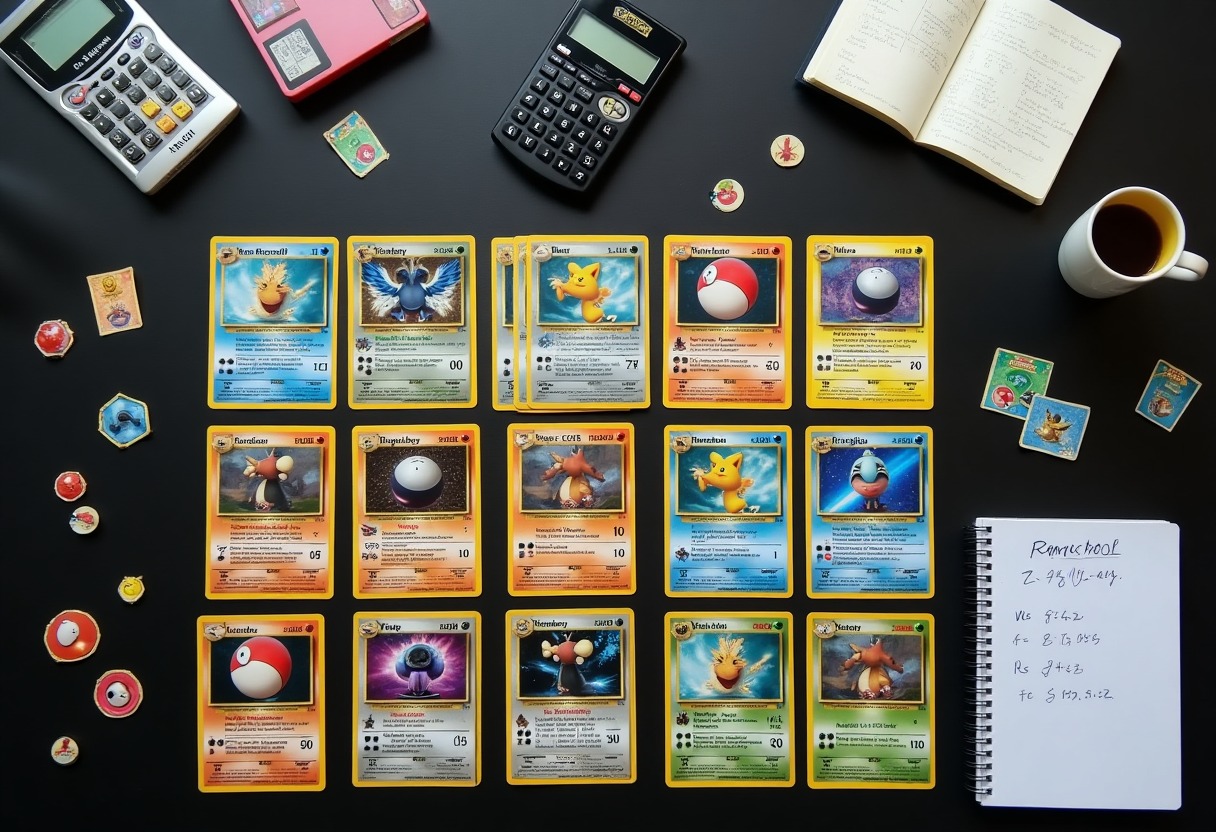
Every tournament loss to bricked hands traces back to one question: what's the actual probability you'll draw your Rare Candy on turn two? The answer isn't guesswork — it's hypergeometric probability, the statistical foundation that separates consistent decks from inconsistent ones. Understanding these calculations changes how you build, test, and pilot competitive lists.
Why Hypergeometric Probability Matters for Deck Building
The hypergeometric distribution calculates exact probabilities for drawing specific cards from a finite population without replacement. Unlike coin flips or dice rolls, each card you draw reduces the deck size and changes subsequent probabilities — exactly how Pokémon TCG works.
The formula: P(X=k) = [C(K,k) × C(N-K,n-k)] / C(N,n)
Where:
- N = total deck size (60 cards)
- K = copies of target card in deck
- n = number of cards drawn
- k = copies of target card you want to draw
This isn't theoretical. Professional players use hypergeometric calculators to determine optimal counts for Boss's Orders (4 copies), Rare Candy (3-4 copies), and basic Pokémon (varies by deck). A Gardevoir ex list running 3 Ralts has a 39.8% chance of opening with at least one copy — acceptable for lists with Nest Ball search. Drop to 2 Ralts and that falls to 27.8%, which explains why decks brick more often than expected.
The official Pokémon TCG mulligan rule requires at least one Basic Pokémon in your opening hand. Understanding mulligan math reveals why basic counts matter more than newer players realize.
Opening Hand Probability: The Seven-Card Baseline
Your opening seven cards determine first-turn setup consistency. Here's the math for key scenarios:
Probability of drawing at least one copy:
- 1 copy in deck: 11.5%
- 2 copies: 21.9%
- 3 copies: 31.4%
- 4 copies: 40.2%
Probability of drawing at least two copies:
- 2 copies in deck: 2.0%
- 3 copies: 5.8%
- 4 copies: 10.7%
For cards you absolutely need turn one (like Ultra Ball or Nest Ball), running 4 copies gives you better than coin-flip odds. For situational cards like Counter Catcher, 1-2 copies works because you don't need them immediately.
This connects directly to our Pokemon Tcg Mulligan Guide, which covers strategic mulligan decisions once you understand these base probabilities.
Optimal Deck Ratios by Card Function
Different card types require different optimal counts based on function and draw timing. Here's the consistency breakdown:
| Card Type | Optimal Count | Turn 1 Probability (≥1) | Reasoning | |-----------|---------------|------------------------|-----------| | Ultra Ball / Nest Ball | 4 copies | 40.2% | Search enablers need maximum consistency; probability compounds with multiple searchers | | Boss's Orders | 3-4 copies | 31.4-40.2% | Late-game critical; 3 works with Iono/Pokémon Ranger for search access | | Rare Candy | 3-4 copies | 31.4-40.2% | Evolution-dependent decks need this turn 2; stage 2 decks run 4 | | Basic Pokémon (primary) | 3-4 copies | 31.4-40.2% | Minimum viable starts; search cards supplement but don't replace | | Tech Supporters | 1-2 copies | 11.5-21.9% | Situational answers you search with Hisuian Heavy Ball or Roxanne |
The math explains tournament deck patterns. Lost Zone decks run 4 Comfey because they need it turn one to enable Mirage Gate. Charizard ex lists run 4 Rare Candy because stage 2 evolution speed determines game pace. Control decks run 1 Iono because they're playing for late game when their deck size shrinks and draw probability increases.
For proper deck storage during testing, check out Best Pokemon Card Binders 2026 for organizing different card counts. Testing multiple ratios requires organization systems that track changes efficiently.
Mulligan Math: How Opponent Draws Affect Probability
The mulligan rule creates asymmetric advantage. Every time you mulligan, your opponent draws one card before you redraw. This affects both players' probabilities:
Your mulligan impact:
- 1st mulligan: 90.1% chance of at least one basic (if running 8 basics)
- 2nd mulligan: 94.3% chance
- 3rd mulligan: 96.9% chance
Opponent benefit:
- Drawing 1 extra card increases their chance of drawing any 4-of by 6.7% absolute
- Drawing 2 extra cards: 13.2% increase
- Drawing 3 extra cards: 19.4% increase
This is why running exactly 8-10 basics minimizes mulligan risk while maintaining consistency. Going below 8 basics risks multiple mulligans that gift your opponent superior opening setups. Going above 12 basics creates dead draws later when you need Supporters or Items.
The optimal basic count varies by archetype:
- Single-Prize attackers: 10-12 basics (need immediate board presence)
- Stage 2 evolution: 8-10 basics (4 primary evolution line + 4-6 secondary/tech basics)
- Mew VMAX: 0 basics in main deck (Genesect V in bench via Fusion Strike Energy)
→ Shop pokemon deck boxes on Amazon helps organize main deck configurations and sideboard basics for best-of-three formats.
Draw Probability Across Multiple Turns
Opening hand probability only tells part of the story. Calculating cumulative draw probability across turns reveals when consistency thresholds hit:
Drawing at least one copy of a 4-of:
- Turn 1 (7 cards): 40.2%
- Turn 2 (9 cards): 48.7%
- Turn 3 (11 cards): 56.4%
- Turn 4 (13 cards): 63.4%
Drawing at least one copy of a 3-of:
- Turn 1: 31.4%
- Turn 2: 38.5%
- Turn 3: 45.0%
- Turn 4: 51.1%
This math explains why Iono disruption works. Shuffling an opponent back to 2-4 cards dramatically reduces their access to specific outs. An opponent with 4 Boss's Orders in a 20-card deck has 38.7% chance to draw one in their next 2 cards. In a 40-card deck, that drops to 18.7% — a 20% absolute difference.
The mathematics also justify running multiple draw Supporters. Professor's Research draws 7 new cards, fundamentally resetting your probability calculations with a fresh sample. Iono draws fewer cards but disrupts opponent calculations simultaneously.
For tracking these probabilities during testing, → Shop pokemon damage counter dice on Amazon doubles as probability trackers for monitoring draw patterns across test games.
Energy Curve Optimization Using Hypergeometric Models
Energy attachments follow the same probability principles but with specific thresholds. Most competitive decks aim for turn 2 or turn 3 attacks, which requires:
Turn 2 attack (2 energy required):
- Running 10 energy: 68.4% chance of 2+ energy in 9 cards
- Running 12 energy: 76.2% chance
- Running 14 energy: 82.5% chance
Turn 3 attack (3 energy required):
- Running 10 energy: 61.3% chance of 3+ energy in 11 cards
- Running 12 energy: 71.8% chance
- Running 14 energy: 80.1% chance
This explains standard energy counts across archetypes. Gardevoir ex runs 10-11 Psychic Energy because Kirlia's Refinement searches specific Energy cards, supplementing natural draw probability. Charizard ex runs 10-12 Fire Energy because Pidgeot ex searches any card, reducing energy count dependence.
For detailed analysis of energy ratios and attachment timing, see our guide on Pokemon Tcg Energy Curve Optimization.
Product Recommendations for Testing Consistency
Building consistent decks requires proper testing infrastructure:
→ Shop pokemon card sleeves on Amazon protects cards during extensive shuffling and draw testing. Standard sleeves (66mm x 91mm) handle the hundreds of shuffles required to verify probability calculations across sample sizes.
→ Shop pokemon playmat on Amazon provides consistent play surfaces for tracking card positions during probability testing. Marked zones help monitor opening hand success rates across iterations.
→ Shop pokemon tcg binder on Amazon organizes different deck ratio configurations for A/B testing. Compare 3-Candy lists against 4-Candy lists with proper storage between test sessions.
For players building budget-conscious consistent lists, our Budget Deck Guide covers affordable staples that maintain mathematical consistency without premium card prices.
Advanced Consistency: Interaction Effects and Search Chains
Hypergeometric probability compounds when cards search other cards. This creates multiplicative consistency that raw probability doesn't immediately reveal:
Example: Gardevoir ex Evolution Chain
- 4 Rare Candy (40.2% opening hand)
- 4 Ultra Ball (40.2% opening hand)
- Combined probability: 64.2% of opening with either Rare Candy OR Ultra Ball
When you can search Rare Candy with Ultra Ball (via discarding for cost, then searching Kirlia to hold Candy target), your effective consistency exceeds single-card probability calculations.
Search Chain Formula: P(success) = P(card A) + P(card B) - P(both cards)
This interaction effect justifies running multiple copies of search cards even when individual probabilities seem sufficient. Four Ultra Balls plus four Nest Balls creates 64.2% probability of opening with at least one search card — not perfect, but high enough for competitive consistency.
The same logic applies to card advantage engines. Running Battle VIP Pass plus Professor's Research compounds your turn-one setup probability. If you don't draw VIP Pass (40.2% chance with 4 copies), you still have Professor's Research (40.2% chance with 4 copies) to reset your hand. Combined probability of drawing either: 64.2%.
Understanding these chain effects separates consistent decks from lucky draws. Every search card you run increases total consistency geometrically, not arithmetically.
FAQ
What's the minimum basic Pokémon count for acceptable mulligan rates in competitive play?
Eight basic Pokémon provides 90.1% probability of avoiding first mulligan in a 60-card deck, which represents the minimum acceptable consistency threshold for tournament play. Below eight basics, you risk multiple mulligans that grant opponents significant card advantage — each additional card your opponent draws increases their probability of accessing key 4-of cards by approximately 6-7% absolute. Decks running fewer than eight basics typically include specific search mechanics (like Mew VMAX running zero basics but using Genesect V placement effects) that bypass normal mulligan risk. For standard stage 2 evolution decks, 8-10 basics balances mulligan consistency against late-game dead draws.
How do you calculate the optimal count for situation-specific cards like Boss's Orders or Counter Catcher?
Calculate optimal counts by determining your target probability threshold for accessing the card by specific game turns. Boss's Orders typically needs 50%+ probability by turn 4-5 (mid-game), which requires 3-4 copies depending on draw support in your deck. Counter Catcher serves as comeback mechanic when behind on prizes, appearing in approximately 40-50% of games where you're trailing — running 1-2 copies provides 11.5-21.9% opening hand probability that compounds to 35-48% probability by turn 6. Test your deck's average game length and identify critical turn windows where each card becomes necessary, then run enough copies to hit 40-60% cumulative probability by that window. Cards with searchability (via Hisuian Heavy Ball or Pokémon Ranger) can run lower counts because search probability supplements natural draw probability.
Does running more draw Supporters meaningfully improve consistency or just cycle through the deck faster?
Running additional draw Supporters improves consistency through probability reset mechanics rather than simple deck cycling. Each Professor's Research draws 7 cards, effectively giving you a fresh hypergeometric calculation with improved odds compared to drawing single cards per turn. Running 4 Professor's Research plus 2-3 Iono plus 2 Judge gives you 8-9 total Supporters, creating 53.5-58.2% probability of opening with at least one draw Supporter. This probability resets your hand multiple times per game rather than incrementally drawing cards. The key is running enough Supporters to access them by turn 2-3 (when setup matters most) while maintaining proper basic Pokémon and search Item ratios. Decks running fewer than 8 total Supporters see measurably lower consistency in tournament data, particularly in games extending past turn 5.
How does prize card distribution affect probability calculations for accessing specific cards?
Prize cards create hidden information that reduces effective deck size from 60 to 54 cards after setup, but you can't calculate exact probabilities for specific cards because prize placement is random. The practical impact: any individual card has 10% chance of being prized each game (6 prizes ÷ 60 cards). Running 4 copies of critical cards reduces the probability that all copies get prized to 0.001% — effectively negligible. Running only 2 copies increases the all-prized probability to 1.89%, which becomes statistically significant across tournament rounds. This mathematics justifies running 4-of for consistency-critical cards and running 3-of for important but non-critical cards. Prize cards also explain why recovery cards like Klara or Super Rod appear in competitive lists — they convert prized resources back into deck resources, effectively improving probability calculations mid-game when prize information becomes partially known.
What's the mathematical justification for running exactly 60 cards instead of 61-64 cards for "better" ratios?
Every card above 60 reduces your probability of drawing any specific card by approximately 1.6-1.7% relative per additional card. Running 61 cards reduces your 4-of opening hand probability from 40.2% to 39.5% — seemingly small but significant across eight tournament rounds. Running 64 cards drops that probability to 37.5%, a 2.7% absolute decrease that translates to approximately one additional game per tournament where you miss critical cards. The only format-legal reason to exceed 60 cards is specific metagame hate (running 61st card as tech against narrow matchup), but this requires the additional card to improve matchup win rate by more than the consistency cost. Mathematical optimization proves 60 cards maximizes consistency for every card in your deck simultaneously — running more dilutes all probabilities proportionally, and the only question becomes whether specific matchup improvement exceeds that dilution cost.
The Numbers Shape Better Builds
Understanding hypergeometric probability transforms deck building from intuition to precision — you're not guessing at consistency, you're calculating it. Run the numbers before testing, verify with actual shuffles, then make ratio adjustments based on data rather than feel. The math determines which decks win tournaments.
Some links on this page are affiliate links. We may earn a small commission if you purchase through them, at no extra cost to you.
As an Amazon Associate we earn from qualifying purchases. This article contains affiliate links; if you buy through them we may earn a small commission at no additional cost to you.
Keep leveling up
More From the Squad
Set reviews, pull-rate data, and the gear the community trusts.